
What Wattage Charger Does Your Phone Need? A Fast Charging Guide
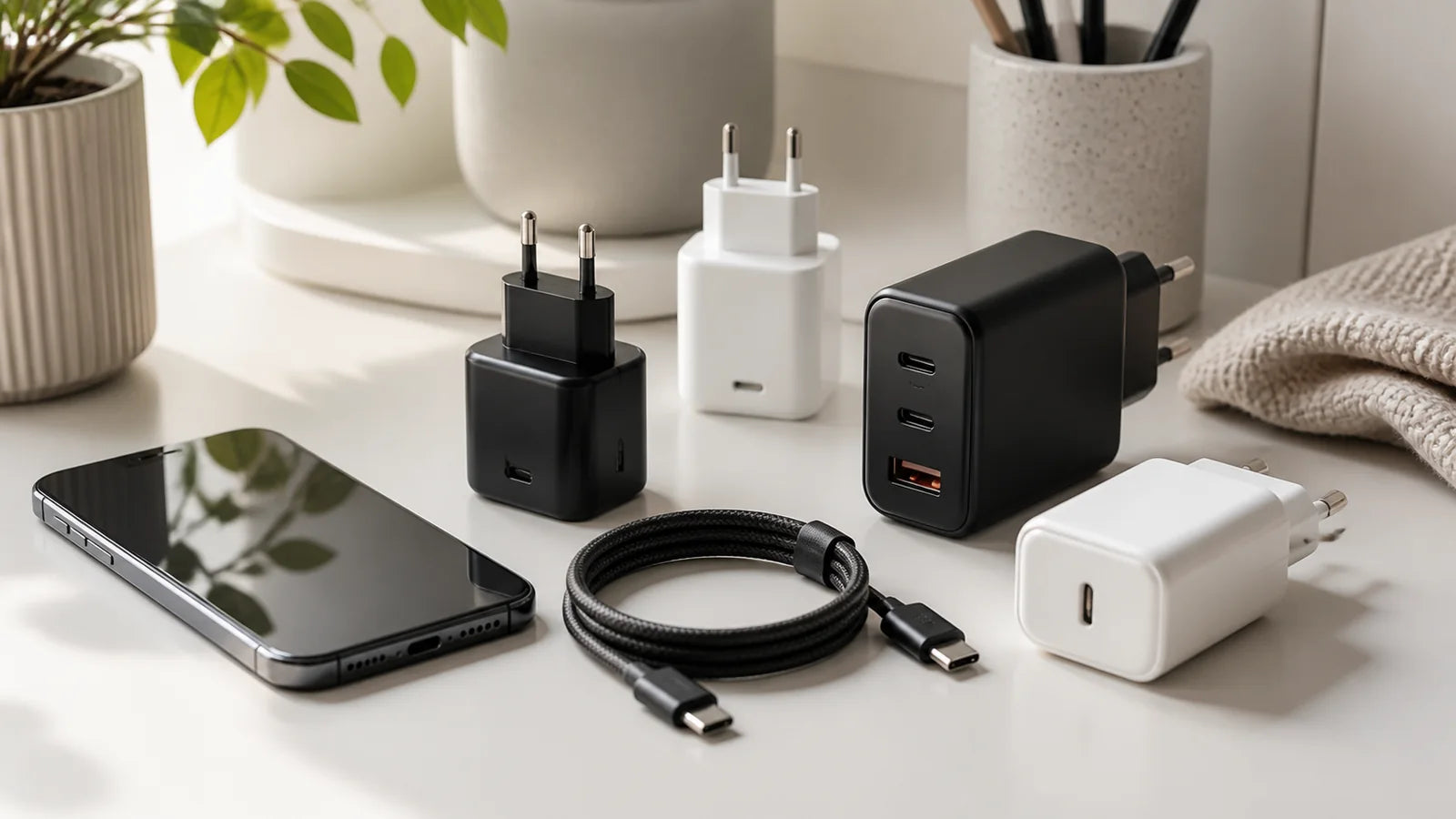
Choosing a phone charger often seems simple – until you see 20W, 25W, 30W, 45W, 65W or even bigger numbers on the packaging. The natural question is: what wattage charger should you choose for your phone so that it charges quickly but safely?
In short: a modern phone usually draws only as much power as it can use. But that doesn't mean it is always worth buying the most powerful charger. What matters is not just the W number, but also the charging standards, the cable, the power your phone supports and heat.
The short answer: what wattage charger do you usually need?
- For an everyday phone: a 20W USB-C PD charger is usually enough.
- For Samsung and many Android phones: a 25W or 30W charger is often a good fit, especially if PD/PPS is supported.
- For a tablet or a phone with a larger battery: it is worth looking at 30W-45W.
- For several devices or a phone + laptop: 65W or more is a practical choice, as long as the charger has several ports.
- For the car: 30W-60W is enough for most phones, while higher power is useful for charging several devices at once.
If you are not sure, the safest all-round choice for a phone is usually a 20W-30W USB-C PD charger from a reliable manufacturer.
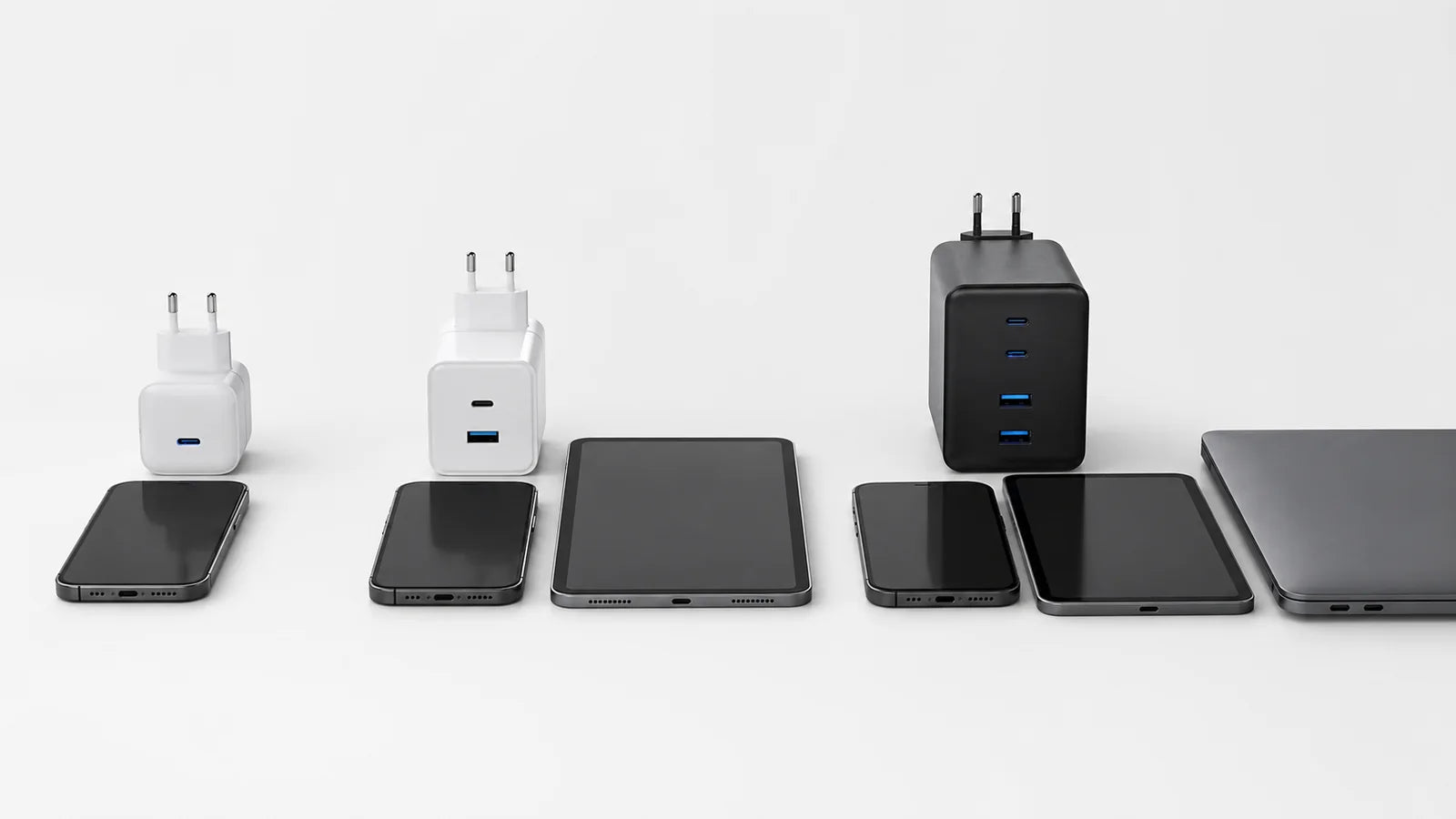
What does W on a charger mean?
W stands for watts – the maximum power the charger can deliver to a device. Simply put, the higher the W number, the more energy the charger can offer. But a phone is not a passive receiver. Together with the charger and the cable, it negotiates which voltage and current will be used.
That is why a 65W charger doesn't mean the phone will always get 65W. If the phone only supports 20W or 25W, that is roughly the rate it will charge at. A more powerful charger simply has more headroom.
How do you find out how many watts your phone needs?
- Check the phone manufacturer's specifications. Look for lines such as "fast charging", "wired charging", "USB Power Delivery", "PPS" or a stated power in W.
- Look at your old original charger. If it says 5V/3A, 9V/2.22A or similar, that helps you understand the supported level. 9V x 2.22A is about 20W.
- Pay attention to the connector. For fast charging, a USB-C to USB-C cable is usually best. Older USB-A cables often limit the power.
- Consider how many devices you will charge. A single phone needs less power than a phone, earbuds, a watch and a tablet at the same time.
- If in doubt, choose the middle option. 20W-30W for a phone is a practical balance between speed, price and heat.
Can a charger that is too powerful damage your phone?
With a quality charger that works to the USB-C PD, PPS or Quick Charge standard, a higher maximum power is usually not a problem. The phone doesn't take the full number printed on the packaging, only as much as its charging controller allows.
Problems usually come not from the high W number itself, but from a poor-quality charger, the wrong cable, overheating or trying to charge an old device with an unknown adapter. That is why it matters more to choose a reliable charger with clear standards than simply the cheapest high-W option.
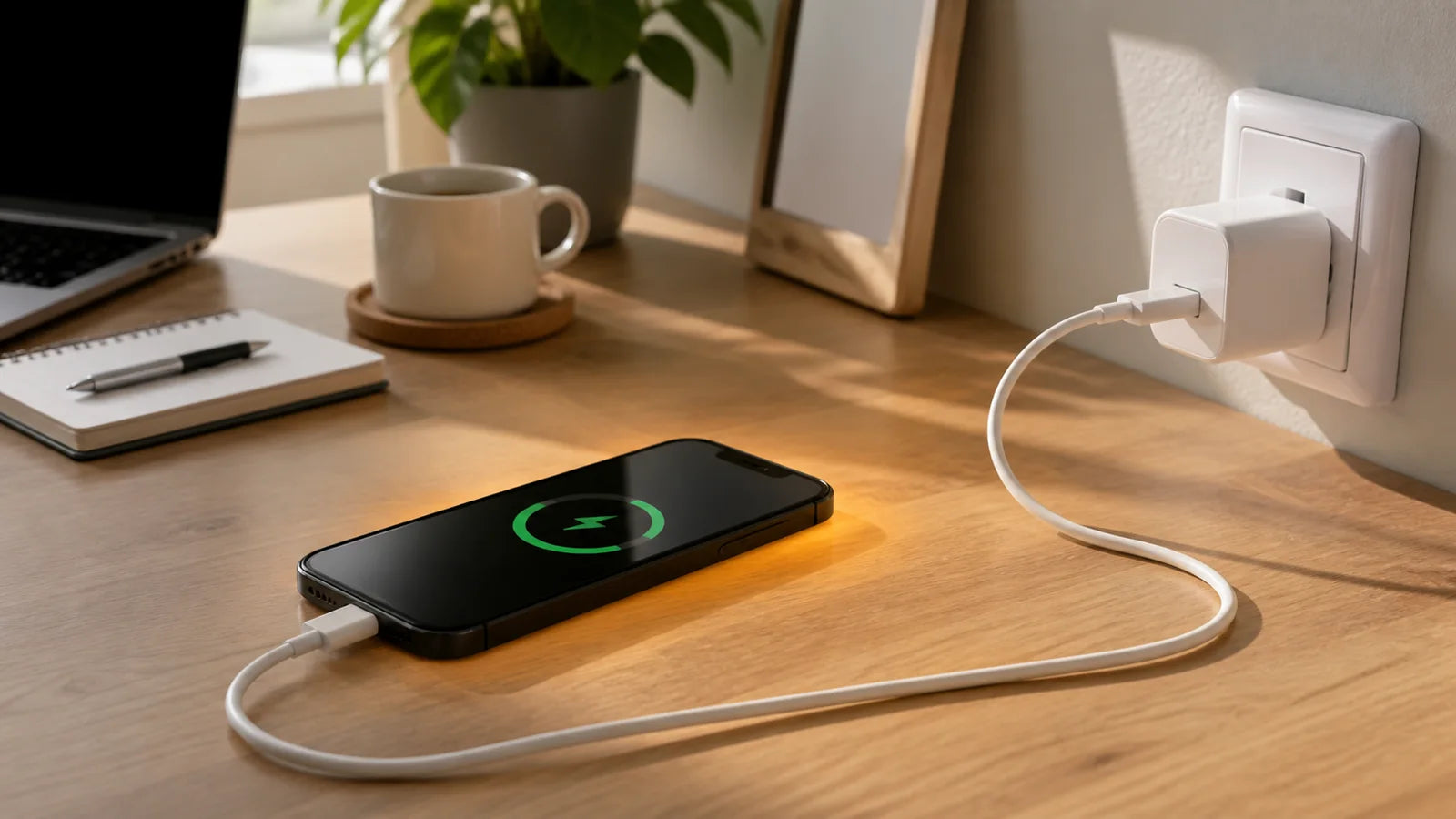
What problems can unsuitable or overly aggressive charging cause?
- More heat. Fast charging can naturally warm the phone up. If the phone is charged under a pillow, in a car in the sun or in a thick case, heat becomes a bigger problem than the W number itself.
- Slower charging than expected. If the charger is powerful but the cable doesn't support the required power, the phone may charge in normal mode.
- Unstable charging. Low-quality adapters or cables can cause interrupted charging, heating or errors on the phone.
- Faster battery wear if the phone often gets hot. What harms a battery most is not fast charging alone, but repeated high temperatures.
- Unused power. If your phone supports 20W, a 100W charger won't charge it five times faster. In that case you overpay for headroom that phone doesn't need.
What power should you choose for each device?
| Device or situation | Recommended power | Worth knowing |
|---|---|---|
| Older phone, earbuds, small accessories | 10W-15W | Fast charging is often unnecessary; stability matters more. |
| Most modern phones | 20W | A good everyday choice, especially with USB-C PD. |
| Samsung and some Android phones | 25W-30W | Look for PD/PPS support if your phone uses it. |
| Tablet, larger battery, faster charging | 30W-45W | Handy if you want one adapter for your phone and tablet. |
| Several devices, laptop, travel | 65W and more | Choose a multi-port GaN charger so the power is shared between devices. |
Why isn't the W number alone enough?
Two 30W chargers can behave differently if one supports USB-C Power Delivery and the other only an older fast-charging mode. For most new phones, USB-C PD is the one to choose. For Samsung phones, PPS support often matters too, because it allows the charging voltage and current to be regulated more precisely.
The cable matters as well. If the charger is 65W but the cable is only made for normal charging, the real power will be limited. A quality USB-C cable is usually enough for a phone, while for higher power, a tablet or a laptop it is worth choosing a cable that clearly supports 60W or 100W.
When is it worth choosing a more powerful charger?
- When you want to charge your phone, earbuds, watch and tablet with one adapter.
- When you use a laptop with USB-C charging.
- When you travel often and want fewer separate adapters.
- When the charger has several ports and clearly states how the power is shared between them.
If you only charge one phone overnight, a 65W or 100W adapter is usually not necessary. In that case, a 20W-30W option makes more sense.
Recommended KAMA chargers by situation
Below are a few practical picks from the KAMA range. Each one is chosen for a different use case, so you don't have to go by the biggest number on the box alone.
- For an everyday phone: Joyroom JR-TCF20 USB-C PD 20W wall charger. A good fit when you need simple, fast USB-C PD charging for one phone.
- For Samsung 25W charging: Samsung 25W EP-TA800EBE USB-C wall charger. A good choice if you want a Samsung-style 25W adapter.
- An all-round 30W choice: Tech-Protect NCA30 PD 30W / QC3.0 USB-A / USB-C wall charger. Handy when you have both USB-C and older USB-A cables.
- For a phone and a tablet: Tech-Protect NC45W-GAN 2-PORT PD45W wall charger. Higher power and two ports make it easier to charge more than one device.
- For several devices or travel: Tech-Protect C65W 2x USB-C PD 65W / USB-A QC3.0 charger. A good fit if you want one adapter for your phone, tablet and some USB-C laptops.
- For the car: Wozinsky WLS-04 60W car charger 2xUSB-C 2xUSB-A. A practical option for trips when you need to charge several devices at once.
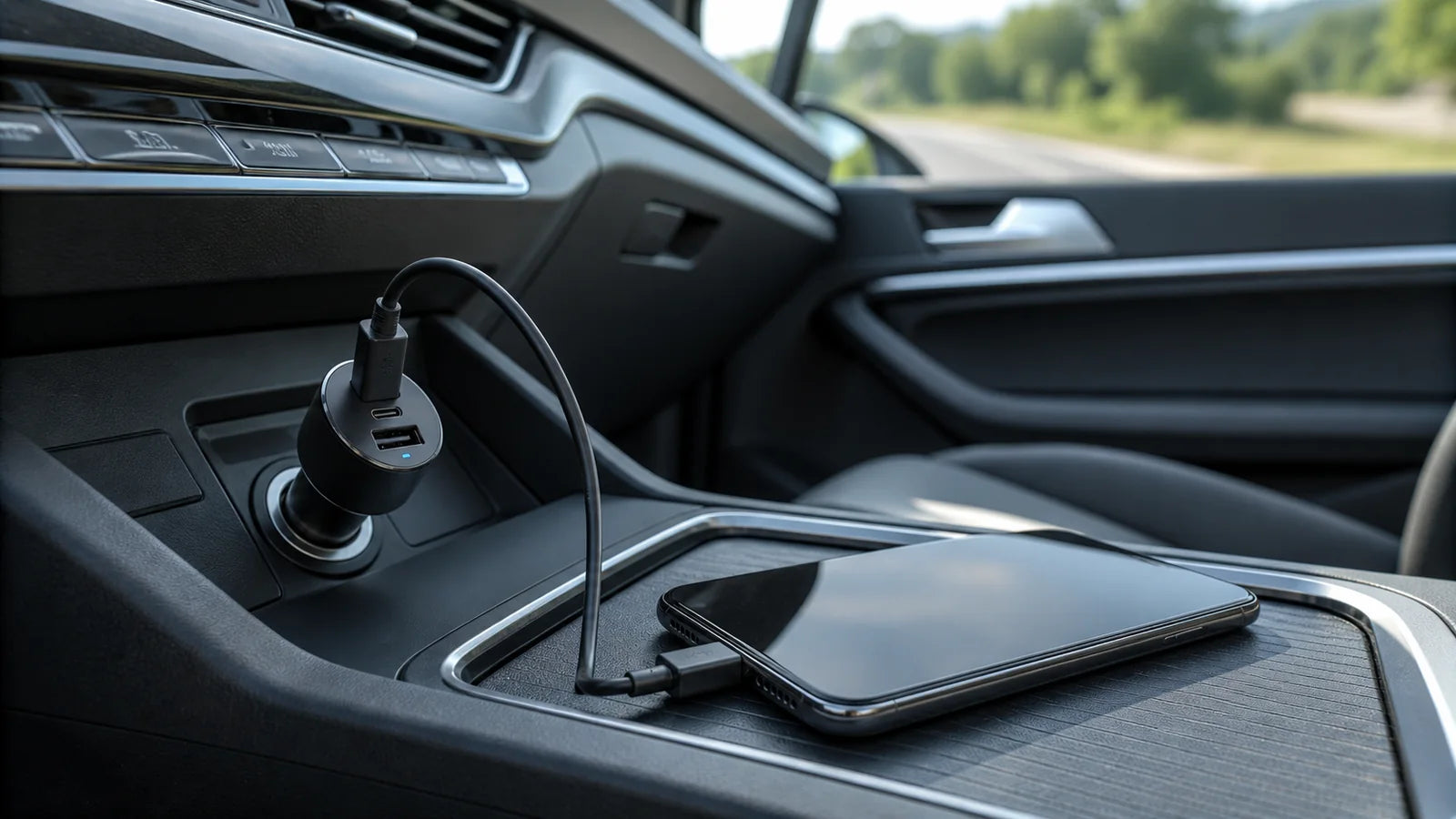
You will find more options in the KAMA chargers category.
The most common mistakes when choosing a charger
- Buying by the highest W number alone. For a phone that supports 20W, a 100W adapter won't be proportionally faster.
- Forgetting the cable. Even a good charger won't work at full capacity with a poor or unsuitable cable.
- Mixing up USB-A and USB-C capabilities. USB-C PD is often the better choice for new phones.
- Charging in a hot environment. If your phone gets warm, take off a thick case, don't keep it under a pillow and avoid direct sunlight.
- Using adapters of unknown origin. A charger is a power supply device, so cutting costs to the extreme is not worth it here.
FAQ: short answers
Can I use a 65W charger for my phone?
Yes, if it is a quality charger with the right standards. The phone will take only the power it needs. Still, if you only charge a phone, 20W-30W is often the more sensible choice.
Will a 30W charger damage a phone that supports 20W?
Normally, no. The phone will limit charging according to its own capabilities. It matters more that the charger and the cable are good quality.
Why does my phone charge slowly even though the charger is powerful?
Common reasons: the wrong cable, the phone doesn't support that much power, the charger doesn't support the required standard, the phone is hot or the battery is already nearly full. Many phones slow down charging as they approach 80-100 percent.
Which is better – 20W or 30W?
For a single modern phone, 20W is often enough. 30W is worth choosing if you want a bit more headroom, have an Android phone that supports higher power or want a more versatile adapter.
Is a GaN charger worth it?
GaN chargers are often more compact and efficient, especially at 45W, 65W or higher. If you want one adapter for several devices, GaN is a good choice.
Final recommendation
If you need a simple answer: for most phones, choose a 20W-30W USB-C PD charger. If you have a Samsung or another Android phone with fast charging, look at 25W-30W and PD/PPS support. If you want one adapter for several devices, a 45W-65W GaN charger with several ports is worth choosing.
A more powerful charger is not automatically dangerous, but it must be good quality and match your devices' needs. The best choice is not the highest W number, but the right balance between power, standards, cable and real-world use.
Straipsnyje minimos prekės
-
Pristatymas 1-3 d.d.Regular price €5,49
20 W · 1 port
-
Pristatymas 1-3 d.d.Regular price €9,99
25 W · 1 port
-
Pristatymas 5-9 d.d.Regular price €8,99
30 W · 2 ports
-
Pristatymas 5-9 d.d.Regular price €17,49
45 W · 2 ports
-
Pristatymas 5-9 d.d.Regular price €25,99
65 W · 3 ports
-


